
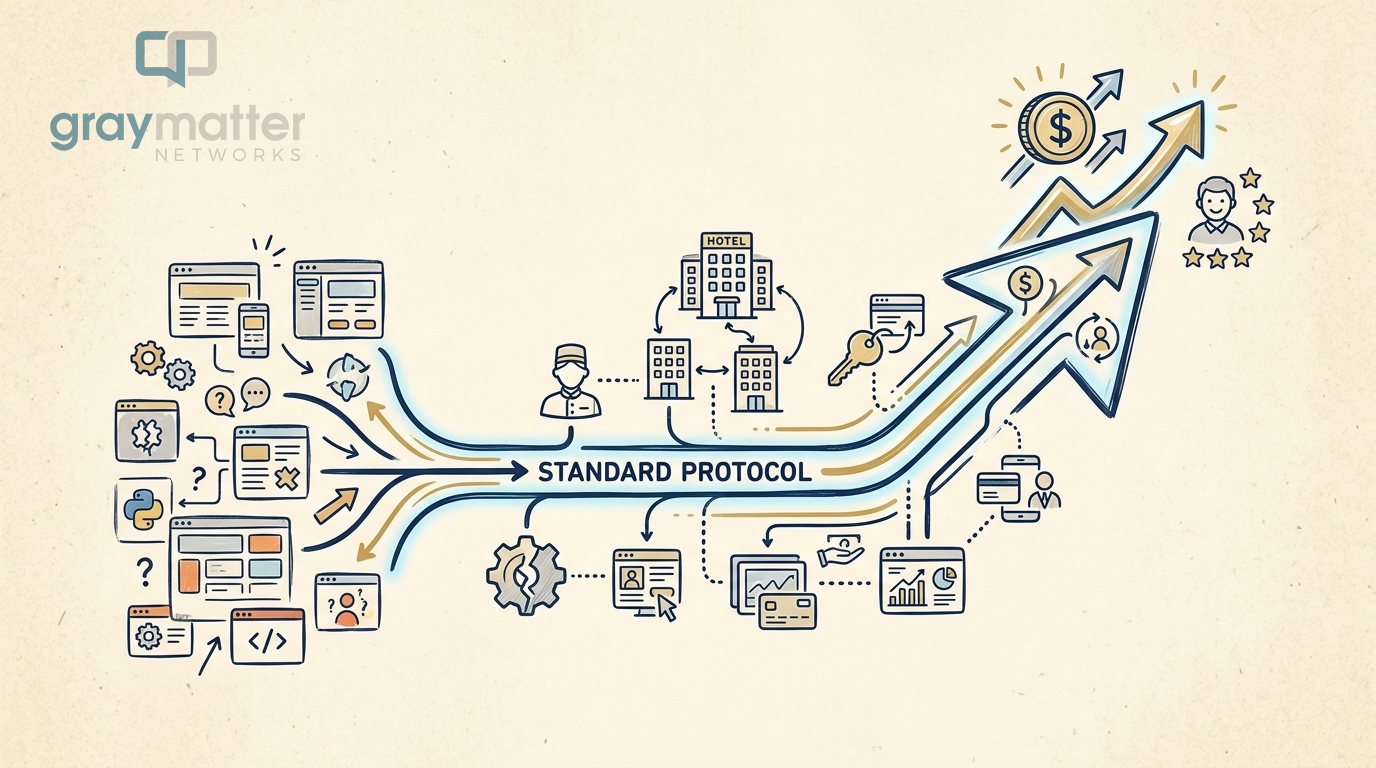

Everyone says they want ROI.
In hotel groups, that conversation usually starts with the wrong math: software cost, hardware cost, implementation cost, and whatever the first property is expected to “save” in year one. That is understandable. It is how projects get approved. It is also why a lot of technology decisions end up being evaluated too narrowly. Across a hotel group, the real return is often not hiding in the first install. It is hiding in what happens after it – when the second, tenth, and fiftieth property become easier to support, easier to train, easier to report on, and harder to break with one-off exceptions.
That sounds obvious now, but hospitality has not always framed it that way. Older strategy research in the hotel sector argued that classic economies of scale from standardization were often limited, because hotels still need local responsiveness. At the same time, that same research pointed out something important: customers valued consistent service standards, and opportunities for better integration of back-office functions were still significantly underexploited. In other words, even when full uniformity was unrealistic, consistency in the invisible parts of the business still mattered.
What has changed is the weight of the technology stack.
A recent academic study on digitalisation and IT strategy in hospitality found that disparate systems and a lack of data integrity are now key issues holding companies back, making digital progress harder than it should be. The Hotel Yearbook’s 2025 hospitality technology survey reached a similar conclusion from the operator side: integration, fragmentation, and lack of industry standards were among the most common frustrations named by hotel companies and tech vendors alike. The report’s language was unusually blunt — hotels are willing to innovate, but many feel trapped in a tech jungle of mismatched pieces.
That is why standardization now lands differently than it did fifteen years ago.
It is no longer just about purchasing leverage or brand consistency. It is about reducing operational drag. The 2026 Hotel Technology Outlook, based on input from more than 300 hotel professionals, found that integration remains a major pain point, with 38 percent of respondents naming it as a top frustration. The same report found that users of all-in-one systems reported more booking errors, more missed preferences, and more check-in delays than users of best-in-class setups. Whether a group prefers a unified core or a best-in-class stack, the pattern is the same: if systems do not connect cleanly and behave consistently, the guest eventually feels it.
This is where standardization starts to become operational, not theoretical.
Hotel Managementhas noted that digital tools across the back office – accounting, night audit, reporting, and related workflows – can reduce manual processes and cut down on time-consuming administrative work. In a separate piece on accelerating tech adoption, the same publication pointed to the most labor-intensive parts of the hotel as the obvious places to centralize and streamline: front desk, back office, and housekeeping. That is a much more useful way to think about standardization. Not as a philosophy. As a way to remove repetitive work, reduce exceptions, and create a cleaner operating rhythm across the portfolio.
The operators who have scaled successfully talk about it that way too.
In Hospitality Technology’s recent profile of PM Hotel Group, the company’s VP of IT and Hotel Systems said, “Consistency across our core platforms creates efficiency,”and added that teams can move between properties more easily when those core systems stay consistent. That line matters because it captures the real group-level return: not just easier procurement, but easier movement of people, easier support, and less reinvention every time a property changes hands or a team member transfers.
Scandic describes the same dynamic from a portfolio-management point of view. In its 2024 annual reporting, the group said it achieves economies of scale through standardized workflows and coordination in areas such as procurement, administration, and investment. In another summary of the same reporting cycle, Scandic said it is committed to continued standardization, coordination, and digitalization to enhance the guest and team-member experience while increasing efficiency. That is a useful phrasing, because it frames standardization as a performance tool, not a brand straightjacket.
And that last part matters.
Because the usual objection is that standardization kills personality.
It does not, at least not when it is done well. Research on service quality has found that standardization and customization are not opposites so much as complementary forces. One study across service sectors, including hotels, found that integrating standardization and customization improves service quality, and explicitly notes that in hotels, standardization helps employees avoid mistakes and deviations while still delivering customized service. That is probably the clearest way to frame the issue. Standardization should not flatten the guest experience. It should protect it from inconsistency.
This is why the real ROI across a hotel group rarely shows up as a flashy number on the first property.
It shows up later, in quieter ways:
faster rollouts, cleaner reporting, easier support, clearer training, less local improvisation, and fewer “special” versions of the same process spread across the portfolio. It shows up when a regional operations leader no longer has to translate between five system behaviors. It shows up when a property can inherit a template instead of inventing one. It shows up when the group can finally compare like with like – not perfectly, but consistently enough to act.
That is the part worth remembering.
The biggest return is usually not that one hotel got a better system.
It is that the group became easier to run.