
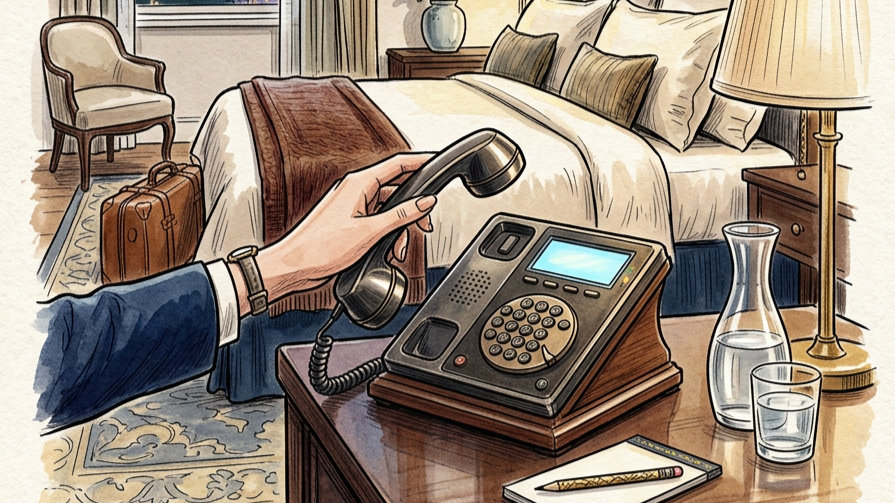

Companion piece to the GrayMatter Networks webinar “Has the room phone lost relevancy?”. – Watch the full webinar here: https://my.demio.com/ref/5mfrI8N0bxQoCP2e
A few months ago, GrayMatter Networks’ CEO and CTO David Maayani was sitting in a friend’s kitchen when his friend looked at him and asked a question that has stuck with him ever since. “David, what are you doing? Why are you still in the business of hotel telephony? Everyone else is moving to AI, to TVs, to Wi-Fi. Surely the phone in the hotel room isn’t relevant anymore.”
It is a fair question, and one that anybody planning, building, or running a hotel today has probably asked themselves at some point. The premise behind it certainly feels right. Hotel guests don’t make business calls from their rooms anymore. They take Zoom calls on their laptops, they message colleagues on Slack, and they use their cell phones for everything else. The phone in the room mostly sits there. Doesn’t it?
The data on how people now feel about phone calls in general is striking. A 2024 Uswitch survey of 2,000 UK adults found that nearly 70% of those aged 18 to 34 prefer texting over talking, with 23% saying they never answer calls at all. The phenomenon even has a name now — telephobia — and it is widely acknowledged across the generations now coming of travelling age. The era when a guest checked into a room, picked up the phone, and called a colleague to confirm tomorrow’s meeting is genuinely over.
So the question seems to answer itself. The room phone has lost its relevance.
Except it has not. It has just changed jobs.
The phone’s job has shifted from revenue to outcomes
Twenty years ago, the room phone was a revenue device. Hotels charged for outbound calls. They sold long-distance access. Some rooms had two or three handsets, dedicated phone lines, and even fax lines, because guests genuinely conducted business from their rooms. The phone earned its place on the desk. Today, none of that is true. Guests do not pay for hotel calls because they do not make hotel calls. The phone in the room generates no direct revenue.
But somewhere between then and now, the room phone quietly took on a different job. Three of them, in fact. None of them are about revenue. All of them matter.
The first job: emergency compliance
In the United States, two pieces of federal legislation have made the in-room phone effectively non-negotiable. Kari’s Law requires that any phone in a multi-line system can dial 911 directly — no nine before, no eight before, no operator authorisation. Anybody must be able to dial 911, from any phone, and reach emergency services unencumbered. The law also requires that someone at the property — the front desk, security, or duty management — is alerted the moment a 911 call is placed, so the team can prepare for first responders to arrive.
The RAY BAUM’s Act adds a second layer. When a 911 call is made from any phone on the property, the system must transmit a dispatchable location to emergency services — not just the hotel’s main street address, but specifically which floor, which corner, and which room. When paramedics arrive, they go directly to the right door.
The practical effect is that hotels in the United States effectively cannot operate without 911-capable phones in every guest room. That single fact has done more to keep the in-room phone alive than any guest demand ever could. And it is not going away — if anything, the legacy systems still in use across older properties are looking increasingly exposed as carriers retire grandfather clauses and the FCC pushes harder on enforcement.
The second job: hotel operations
The two most common phone calls a hotel room phone now makes are not business calls at all. They are a wake-up call from the front desk to the guest, and a service follow-up after a request — did you get the towel, did you get breakfast, is everything okay? These calls do not generate revenue, but they do generate guest satisfaction, which is the number that actually matters in hospitality.
Beyond those two, the in-room phone is also the foundation for room status codes (still used by housekeeping in select-service and three-star properties far more often than people realise), guest service requests, and the hundreds of small operational interactions that keep a busy property running. When the phone system is integrated with the property management system — when it knows who is in which room, what the room status currently is, and what the guest’s history looks like — the phone becomes part of operations rather than something separate from them.
The third job: the foundation for AI
This is the one that often gets missed in the conversation. AI voice agents are now genuinely useful in hospitality — handling routine guest requests, taking room service orders, answering questions about pool hours and breakfast times, and freeing the front desk to focus on the guests physically standing in front of them. But every one of those AI agents has to live somewhere. They have to plug into a phone system. They cannot exist in a vacuum.
A hotel without a modern, software-based phone system has nowhere to plug an AI agent in. A hotel running a legacy PBX from twenty years ago has nowhere to plug an AI agent in. The hotels currently deploying AI guest agents successfully are doing so on top of phone systems that were already in good shape. The phone system is not being replaced by AI. It is being upgraded into a platform that AI can sit on.
Which means the relevance of the room phone is not a question that can be answered in isolation from the rest of the technology stack. The phone is the floor. Everything else — from emergency response to guest experience to the next generation of AI — is built on top of it.
So has the room phone lost relevance?
The honest answer is yes — and no.
Yes, it has lost relevance as a device for guests to make and receive personal calls. That ship has sailed. Telephobia is real. Guests are not going to start dialling colleagues from a hotel room desk again.
No, it has not lost relevance as a piece of safety, compliance, and operational infrastructure. If anything, it has gained relevance there. Emergency compliance laws have become stricter. Hotel operations have become more dependent on connected systems. AI guest agents need somewhere to live.
The room phone is not a relic. It is a different device than it used to be, doing a different job than it used to do. The hotels that recognise this — and treat the phone system as operational platform rather than legacy expense — are the ones that will be ready for whatever the next decade asks them to do.
If you missed our webinar when we discussed this, you can watch the whole thing here: https://my.demio.com/ref/5mfrI8N0bxQoCP2e